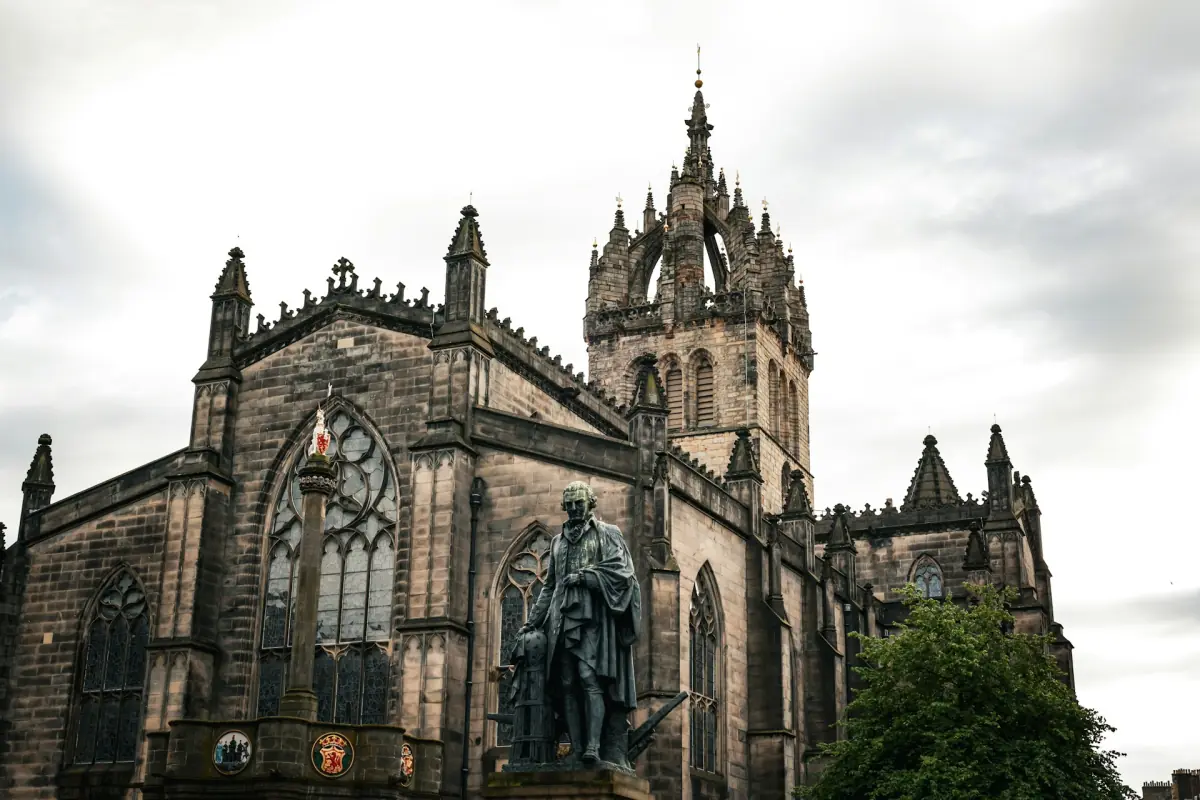
St Giles' Cathedral history: the foundation and medieval church
St Giles' Cathedral history begins in 1124, when King David I founded a church with a Romanesque building. Much of the medieval fabric of the church you see today dates from 1385 to 1410. Keep those dates separate as you look around: they distinguish the founding of the church from the medieval construction that still shapes the building.
Begin with the exterior and its crown spire, then use the visiting guide to plan time inside. The main church and the Thistle Chapel both come with standard visitor admission. The chapel adds a later chapter to the building's history.

History walks around St Giles
Choose the actor-led private walk for storytelling or the Royal Mile route for three Scottish tastings. The Old Town history walk pairs a guide with a walking route past St Giles.
Hand-picked tours, booked through GetYourGuide. Prices are indicative starting prices in British pounds (as of November 2026). Tap a tour for live availability and the current price in your currency.

Old Town stories with an actor
- Expert guide
- Actor and storyteller
The private route includes St Giles as a stop. Cathedral entry is not specified.
Check availability →
Royal Mile history and Scottish tastings
- St Giles' Cathedral exterior
- Expert local guide
- Scottish tastings at three stops
Tron Kirk and John Knox House are also exterior stops. Tastings may take place indoors or outdoors.
Check availability →
Old Town history and tales
- Guide
- Walking tour
St Giles is among the landmarks on this walk. Cathedral entry is not specified.
Check availability →Old Town history walks with St Giles' Cathedral
Follow the cathedral through a wider Old Town history walk, see the exteriors of St Giles' and John Knox House, or choose a private storyteller.
John Knox and the Scottish Reformation
St Giles' Cathedral became part of John Knox's story in 1559, a year before the Scottish Parliament passed its Reformation legislation in August 1560. Parliament ended papal authority over the Scottish church and abolished the Mass. Knox became the elected minister of St Giles', where the changes soon altered the way the interior was used.
In the following year the Protestant town council had the altars and statues removed, the church silver and reliquaries sold and the interior whitewashed. Seating was put in for sermons. When you enter the church today, those changes give you a way to picture an earlier congregation and the part preaching played in its worship.
How St Giles' got its cathedral name
St Giles' became the cathedral of the Edinburgh diocese under Charles I in 1633. In 1638 the General Assembly abolished the bishops. The cathedral name endures at a church that today belongs to the Church of Scotland and worships in the Presbyterian tradition. When planning a visit, use the guide to services and sightseeing times to distinguish the church's different uses.
The crown spire and later restorations
The crown spire at St Giles' Cathedral is medieval in origin and was substantially altered in the seventeenth century. Timber from the inner bell tower gives felling dates from the winter of 1453/1454 to the winter of 1459/1460. Those dates place the cutting of the oak in the fifteenth century. The crown's visible stonework has its own construction and alteration history.
William Burn reworked and refaced much of the exterior from 1829 to 1833. William Hay and George Henderson led further restorations from 1870 to 1883. Look at the silhouette first and then at the façades below to appreciate how much of the church's story is visible from the street.
History walks with a stop at St Giles' Cathedral
At St Giles' Cathedral, a guided history walk puts the church among the landmarks of the Old Town. Choose the walk from 192 High Street for a broad history of the area, the walk with exterior stops at St Giles' and John Knox House for those two landmarks, or the private storytelling walk from Holyrood Palace for Old Town history told by an actor and storyteller. The walking tour guide covers other ways to build a route around the cathedral.
Questions about the history of St Giles' Cathedral
When was St Giles' Cathedral founded?
1124 is the year David I founded the church that became St Giles' Cathedral. The first building was Romanesque. Much of the surviving medieval fabric dates from 1385 to 1410, and later restorations shaped the exterior that you can see from the High Street today.
Why is St Giles' still called a cathedral?
St Giles' Cathedral takes its name from its role as the cathedral of Edinburgh's diocese, established under Charles I in 1633. The General Assembly abolished the bishops in 1638. The name has endured, and the church today has a Church of Scotland congregation with a Presbyterian worship tradition.
Can I see St Giles' and John Knox House on the same walk?
Yes. St Giles' Cathedral and John Knox House are exterior stops on the Old Town history walk that starts at the Queensberry Memorial in West Parliament Square. If you also want to see inside the cathedral, leave time for a separate church visit during its sightseeing hours.